
That’s the text I received from Brubaker, Inc. ahead of my HVAC system’s summer check-up. “Abbie. That could be a woman,” I thought to myself. “Then again, it could be a man,” I mused, thinking of Abbie Hoffman, the ’60s activist who had a female-sounding first name.
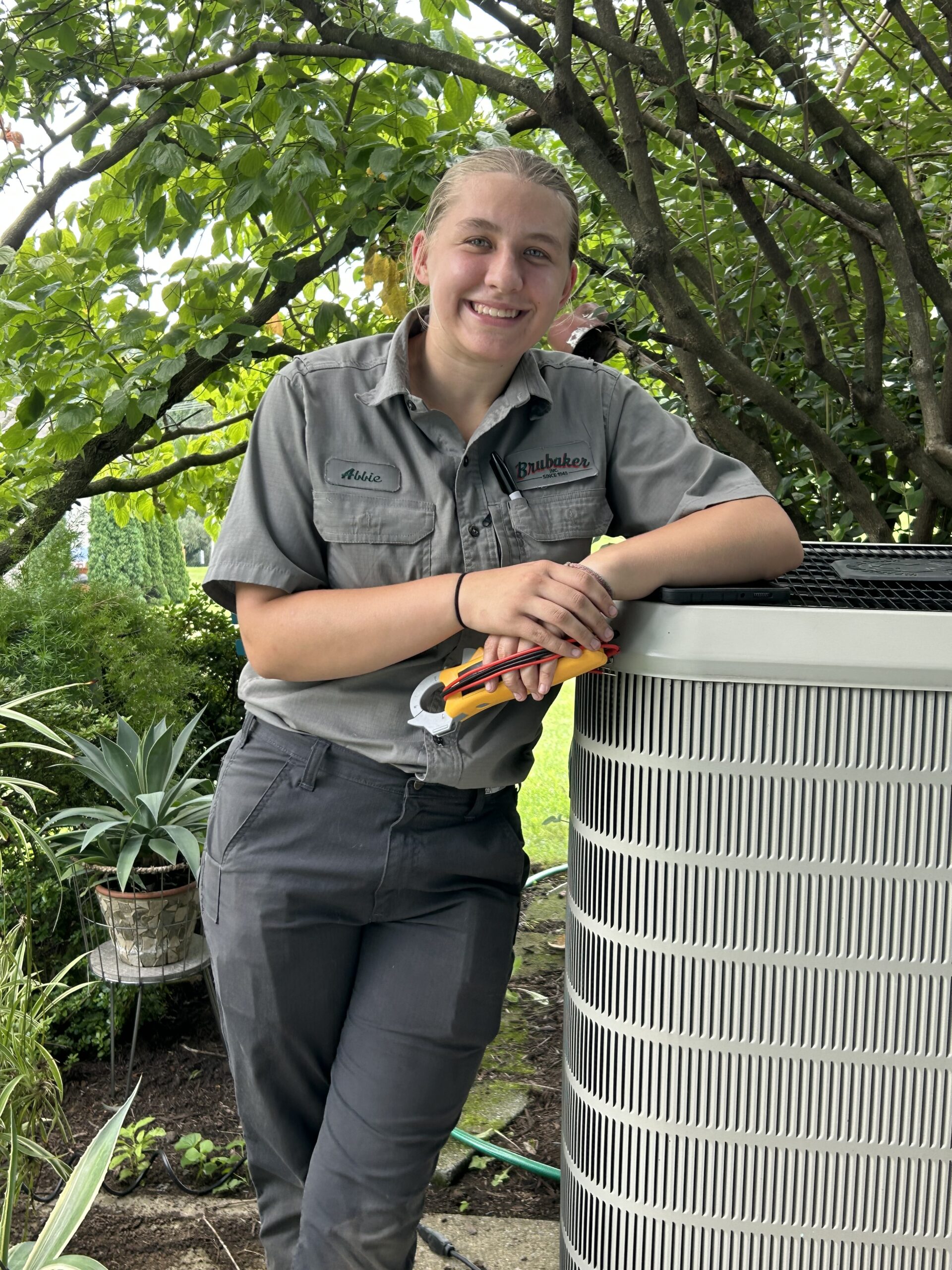
Abbie Hanlon
The doorbell rang and there stood Abbie, as in definitely a young woman. Okay, then. I never had a technician of the female persuasion work on my HVAC system (not that there’s anything wrong with that!). It became evident I had no worries. Abbie was very professional, explaining exactly what she’d be doing during the appointment and estimating how long it would take. Occasionally, she’d pop upstairs to ask a question or see if it’s okay to move a plant container or furniture on the patio.
Curiosity got the better of me and I had to ask: How and why did Abbie become a technician in what is generally regarded as a man’s world? Abbie said that for some reason, she grew up fascinated by the electrical process. “I thought about becoming an electrical engineer, but I really wasn’t interested in going to college,” she explained. Instead, the 2024 graduate of Elizabethtown Area High School set her sights on learning a trade early and enrolled in the curriculum offered by the Lancaster County Career and Technology Center. “I started out at the Mount Joy campus and ended my studies at Brownstown,” she added.
Abbie, who shared that she has always enjoyed working with her hands, answered the call from Brubaker, Inc. to join their team. “I started working with them right out of high school,” she noted, adding that the company also employs another female technician. “As far as I know, I’m the only female HVAC tech in Lancaster County,” she reported. After receiving on-the-job training in servicing residential systems, Abbie began working solo. “The thing I like about working on HVAC systems is that it touches on electrical and plumbing … a little bit of everything,” she commented.
“When I call customers to say I’m on my way, they automatically assume I’m the dispatcher,” she shared. “Some are really surprised to see me standing at their front door!”
Abbie’s role as a technician at Brubaker, Inc. extends beyond simply being an employee. Brubaker, Inc. is now an employee-owned company, which means Abbie is now a business owner. Not bad for someone who graduated from high school a little more than a year ago! You go, girl! I’ll definitely request Abbie when scheduling my winter check-up rolls around.
Becoming the Rule Rather Than the Exception
It seems that Abbie is representative of an educational shift that her generation is embracing. Newspapers, business magazines and websites are filled with stories about the phenomenon that is seeing high school students forgo college and instead enroll in vocational and trades schools, as well as take advantage of on-the-job-training programs that a growing number of companies offer. With tuition and living expenses skyrocketing, high school students are questioning whether college provides a good return on investment (ROI). Instead, they are viewing the trades as a way to earn a good living without the worry of repaying student loans. Those with entrepreneurial goals see a trade as the route to starting their own business.
That shift in perception is also influencing parents. According to a recent story in The Washington Post, for the first time in generations, parents are in sync with their children and are no longer viewing college as the only path to a career. Many are encouraging their children to take a hard look at learning a trade. As a result, the number of people ages 17 to 21 with 2-year vocational degrees is at its highest level since 1992, when such statistics (based on Department of Labor statistics) began to be tracked.
The shift in perception also has to do with the future, as new avenues for trained workers are opening in smart-home technology, cyber security, climate change needs, manufacturing and the automotive industry, specifically in the electric vehicle division.
The generational shift has prompted trade and vocational schools to take notice. Commenting in an article that appeared in Forbes magazine last November, Cliff Whittingstall, the managing senior principal at PBK, an architecture and engineering firm based in Texas, noted, “The perception of trade schools has undergone a significant transformation. Today, trade schools are no longer seen as less prestigious, limiting, or associated with ‘dirty’ work. Instead, they are recognized as essential gateways to rewarding, in-demand careers.” He pointed out that, “Young people are recognizing that pursuing a trade offers stability, financial success, and the ability to start their careers earlier without the financial strain of student debt. Students can enter trade and workforce development programs as early as high school, equipping them with the necessary skills and certifications to begin earning right away.”
Even the look of trade schools has evolved. “Modern training centers are no longer tucked away in dark, poorly equipped corners of schools,” says Whittingstall. “Instead, they feature well-designed and well-lit spaces with advanced machinery. Glass walls, daylighting, and interior visibility allow students and visitors to see these trades in action, showcasing the learning environment, highlighting the technical skill required, and the pride students take in their work. By investing in high-quality facilities, educational institutions are elevating the status of trade programs and making them more appealing to prospective students who might otherwise consider a four-year degree.”
The trades have had a long-time and vocal advocate in Mike Rowe, who is known for hosting the show, Dirty Jobs on Discovery, and narrating reality shows such as Deadliest Catch. He is also the founder of The Mike Rowe WORKS Foundation, which awards $1 million in scholarships annually to students who “demonstrate a strong work ethic, take personal responsibility and project a positive attitude.”
The WaPo article pointed out that vocational and trade schools have adopted savvy ways of attracting students. They’ve realized this new generation of potential students “lives” online, hence recruitment open houses and business expos are giving way to slick TikTok and social media videos that feature actual students touting their decisions. Such TikTokers have gained the distinction of being known as “blue-collar influencers.”
There’s also another reason why younger generations are contemplating trades careers. As baby boomers continue to retire from their chosen trades and because their children (and even grandchildren) perceived college as the only route to success, the demand for trades people to fill vacancies is at unprecedented levels. The building industry is a prime example. According to the Association of Building Contractors, which is celebrating its 75th anniversary this year and represents 23,000 members across 67 chapters, the workforce will need an additional 440,000 trades people to fill vacancies nationwide in order to complete projects that got underway in 2025.
Leave a Reply